African Mythology vs Greek Mythology: How Civilisations Used Myth to Organise Power, Knowledge, and Memory

African mythology and Greek mythology compared through function, worldview, and civilisational purpose, examining how myth organised power, ethics, time, and consequence..

Chinenye Egbuna Ikwuemesi

12/24/20255 min read

This essay forms part of the African Mythology canon.

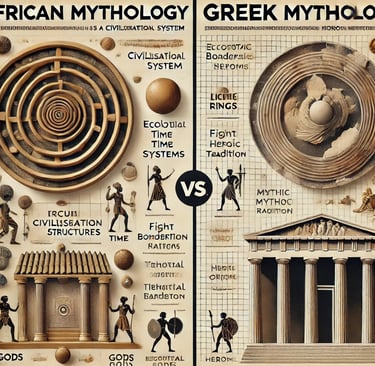
Comparisons between African mythology and Greek mythology are often framed as comparisons between story traditions. That approach misses the point. In both cases, myth was not primarily entertainment. It was a mechanism for organising how societies understood reality, authority, and human obligation. Where they differ is not in sophistication, but in function.

Greek mythology developed within city states that prioritised individual achievement, political competition, and philosophical abstraction. African mythological systems developed across societies that prioritised continuity, collective responsibility, ecological balance, and long memory. These differences shaped how myth was used, preserved, and interpreted.

Understanding the contrast requires moving beyond character lists and heroic tales to examine what myth was doing inside each civilisation.

African Mythology as narrative versus African Mythology as infrastructure

In Greek tradition, myth frequently functions as narrative explanation. Stories describe the origins of the world, the genealogy of the gods, and the dramatic actions of heroes who struggle against fate, gods, or one another. Meaning is often derived from conflict. Moral insight emerges through tragedy, transgression, and consequence, but the story itself remains central.

In many African societies, myth functioned less as narrative spectacle and more as infrastructure. Stories existed, but their purpose was regulatory. Myth encoded how land could be used, how authority was legitimised, how time was structured, and how violations were addressed. The story was not the end product. The behaviour it enforced was.

This distinction matters. Greek myth invites interpretation. African myth demands alignment.

The role of gods and forces

Greek mythology is organised around a pantheon of anthropomorphic gods whose personalities, rivalries, and desires mirror human society. Power is often personal. The gods intervene directly, reward favourites, and punish rivals. Divine conflict reflects political conflict.

African mythological systems tend to frame divine forces as jurisdictions rather than personalities. Deities, spirits, and ancestral forces are associated with domains such as land, water, iron, fertility, justice, or transition. Their authority is not arbitrary. It is conditional. Humans do not bargain with these forces through flattery or loyalty alone, but through adherence to obligation, ritual, and restraint.

This is why the question of a single supreme or most powerful god does not translate cleanly across African systems. Authority is distributed. Balance matters more than dominance.

Heroes and moral emphasis

Greek heroes are often defined by exceptional individual capacity. Strength, cunning, or intelligence elevates them above others. Their failures are tragic, but their distinction from ordinary people is central to the story.

African mythological heroes are more often defined by responsibility than exceptionalism. They are tested not by whether they can win, but by whether they can maintain balance, respect limits, and carry knowledge forward. Failure is instructive. Success is measured by continuity rather than conquest.

In this sense, African myth does not glorify the breaking of rules. It examines what happens when rules are ignored.

Time, fate, and consequence

Greek mythology frequently treats fate as an external force. Even the gods are subject to it. Humans struggle against destiny, sometimes heroically, sometimes futilely. Time moves toward inevitable outcomes.

African mythological systems tend to treat consequence as relational rather than fixed. Actions ripple across time, affecting lineage, land, and future generations. Time is layered rather than linear. The past remains active. The future is shaped by present restraint.

This difference produces distinct moral logics. One asks how individuals face inevitability. The other asks how communities sustain equilibrium.

Preservation and transmission

Greek mythology became canonised through written texts that survived political collapse and were later absorbed into European educational systems. This preservation shaped its modern dominance.

African mythological systems were preserved through a combination of written records, symbolic scripts, material archives, and disciplined oral transmission. Many written and material records were deliberately destroyed or dispersed through conquest, conversion, and colonial administration. Oral systems endured precisely because they were resilient, adaptive, and publicly accountable.

The imbalance in survival should not be mistaken for imbalance in complexity.

A note on comparison and correction

Comparing African and Greek mythology is not an exercise in hierarchy. It is an exercise in understanding how different civilisations used myth to organise reality. The dominance of Greek mythology in modern education reflects historical power, not universal applicability. Re-examining African mythology on its own terms restores visibility to systems that governed large, complex societies for centuries.

This comparative approach informs the work of institutions such as the Afrodeities Institute, where mythology is studied as a civilisational tool rather than a cultural curiosity.

Why this comparison matters

Modern societies continue to rely on mythologywhether acknowledged or not. Ideas about progress, scarcity, success, and inevitability shape political and economic systems in much the same way ancient myths once did. Examining how African and Greek mythologies structured responsibility, power, and consequence offers insight into why some systems prioritise domination and others prioritise balance.

The comparison is not about choosing one tradition over another. It is about recognising that mythology has always been a technology of governance. Different civilisations built different tools.

Understanding that difference clarifies both history and possibility.

FAQs

Who is the African god equivalent to Zeus?
There is no single Africa-wide equivalent to Zeus because African mythological systems are not one unified pantheon. In some traditions, people compare Zeus to a supreme sky authority or creator, such as Ọlọrun or Olódùmarè in Yorùbá religion, but the equivalence is limited. Zeus is a highly personified ruler within a pantheon, while many African supreme beings are less anthropomorphic and operate as ultimate authority rather than a rivalrous character among peers. Wikipedia

Who is the main god in Africa?
There is no single main god for Africa because Africa contains many distinct mythological and spiritual systems. Each tradition has its own cosmology, hierarchy, and sacred jurisdictions. Treating Africa as one pantheon flattens difference and creates misleading rankings that do not map onto how these systems are structured.

Did the Greeks know about Africa?
Yes. Greek societies had contact with Africa through trade, travel, and political interaction, especially with Egypt and North Africa, and Greek writers discuss regions they associated with “Libya” and “Aithiopia.” Their knowledge was partial and shaped by the geography and politics of their time, but Africa was not unknown to the Greek world. The Center for Hellenic Studies+1

Did Africans know God before Christianity?
Yes. Many African societies held concepts of supreme being, creation, moral order, and spiritual accountability long before Christianity arrived. These concepts varied by culture and were expressed through different names, cosmologies, rituals, and sacred obligations. Christianity later interacted with and sometimes attempted to replace or reinterpret those existing frameworks.

Who is Aphrodite in African mythology?
Direct one-to-one equivalents are rarely accurate because mythologies encode different social and moral logics. That said, people sometimes compare Aphrodite to deities associated with love, beauty, fertility, or rivers in specific African traditions, such as Oshun in Yorùbá religion. The comparison is thematic rather than structural, since Aphrodite’s role in Greek myth does not map perfectly onto Oshun’s sacred jurisdiction. Wikipedia

Who is Oshun in Africa?
Oshun is a revered river deity in Yorùbá religion, associated with beauty, fertility, love, prosperity, and sweet waters, and she is also linked to destiny and spiritual power in ritual life. She belongs to a specific tradition and should not be treated as a representative figure for the whole continent. Wikipedia

What do Zulu people call God?
In Zulu tradition, uNkulunkulu is widely referenced as a first ancestor and creator figure in origin narratives, and related Nguni concepts such as uMvelinqangi are also used in some contexts to refer to a most-high source. Usage varies across history and interpretation, including the influence of later religious translation. Wikipedia+2Wikipedia+2

Why are African mythologies sometimes viewed as witchcraft?
This is often the result of colonial and missionary framing that labelled indigenous spiritual systems as illegitimate or dangerous in order to justify conversion, governance, and cultural replacement. In many African contexts, ritual and spiritual practice functioned as moral regulation, communal accountability, and environmental governance, not as a category of deviance. The label reflects power and history more than it reflects the internal logic of the systems themselves.