Exploring Goddess Atai in Efik Mythology
Discover the role of Goddess Atai in Efik mythology and Nigerian mythology. Learn how she can help you understand your destiny and fate in the enchanting world of the Shadow Sky.
Chinenye Egbuna Ikwuemesi
12/2/20242 min read
Atai: Destiny, Mediation, and the Efik Understanding of Divine Will
In Efik theology, the question of whether human beings control their own lives is not answered simply. It is held in tension. And the deity who holds that tension is Atai.
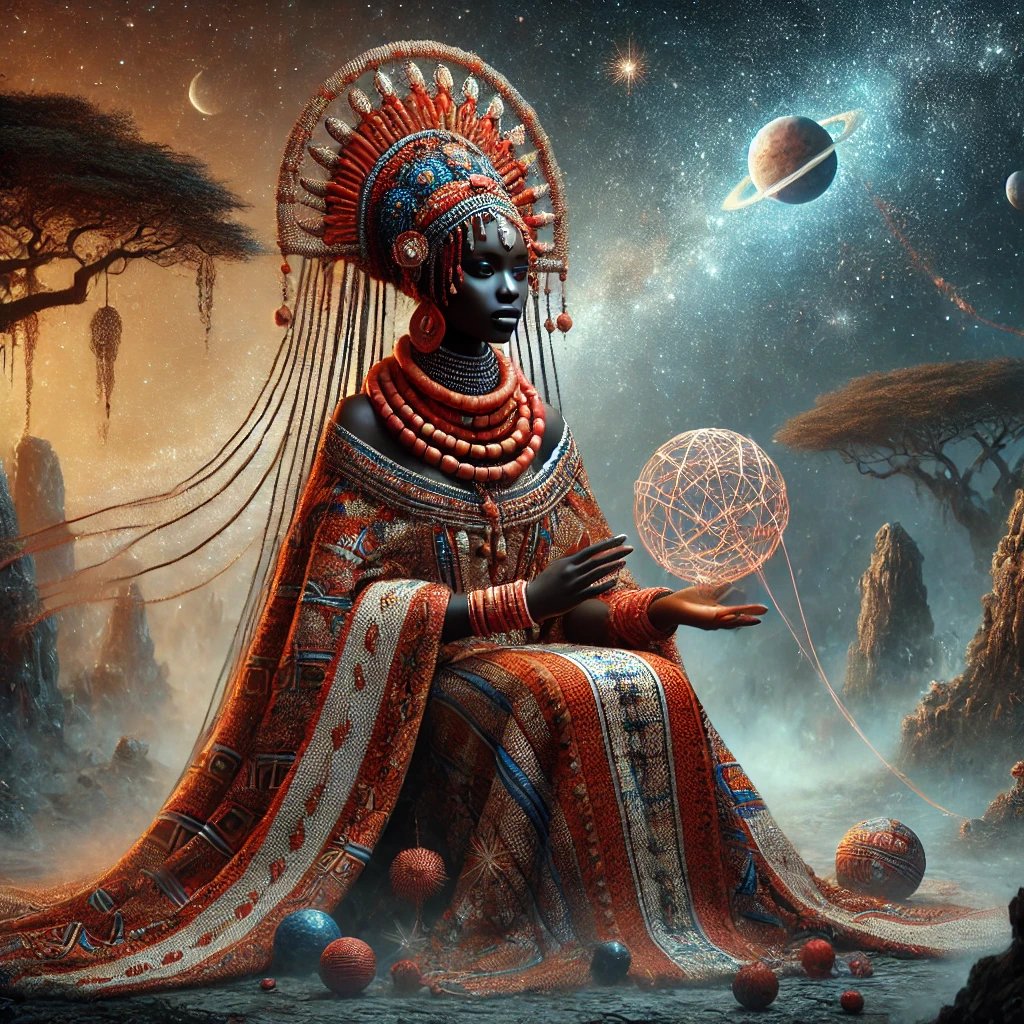
Atai is the goddess of mediation, destiny, and divine intervention in Efik mythology. She stands between Abasi, the supreme god, and humanity, not as a barrier but as a bridge of a particular kind. One that moves in both directions, carrying human need upward and divine correction downward. Her role is not passive. She is an active force in the management of the relationship between the divine and the human.
Her most significant myth makes this clear. When Abasi agreed to allow humans to live on earth, it was under strict conditions. They were not to cultivate food. They were not to procreate. When those conditions were broken, it was Atai who intervened, separating humanity from the divine realm as a consequence. She is simultaneously the advocate who argued for human presence on earth and the enforcer who acted when the terms were violated. That combination is not contradiction. It is the full picture of what mediation actually means. Care and accountability are not opposites.
This places Atai at the centre of a sophisticated theological position on destiny. In Efik belief, fate and destiny are not the same thing. Fate describes the framework, the major structures of a life, birth, death, the broad conditions of existence, that are set by forces beyond individual control. Destiny is what happens within that framework. It is malleable. It is shaped by choice, by prayer, by how a person moves through the life they have been given. Atai governs the relationship between the two. Devotees pray to her in moments of uncertainty because she is the one who can mediate between what is fixed and what can still be changed.
This is a precise and demanding theology. It does not offer the comfort of full determinism, where nothing is your fault because everything was preordained. Nor does it offer the burden of full autonomy, where everything that goes wrong is solely your responsibility. It holds both. You have agency. That agency operates within a structure. And when you lose your way within that structure, mediation is available, but it comes with consequence.
It is worth saying clearly that this understanding of destiny and divine mediation is specific to Efik theology. It should not be read as a universal African position. African mythological traditions are not a single system. They are distinct, specific, and deserve to be engaged on their own terms.
Atai is one of the deities explored in Nigerian Mythology: The Shadow Sky, which documents the belief systems and divine logics of the Igbo, Yoruba, Hausa, and Efik traditions. Her theology is one of the most nuanced treatments of human agency and divine oversight in the Nigerian mythological canon.