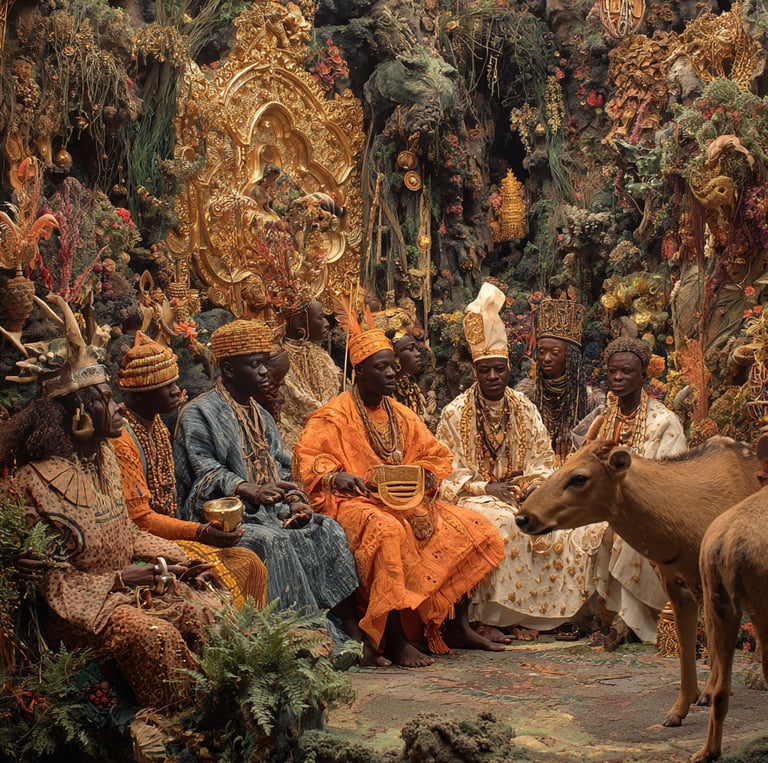
Myth as Instruction and Moral Technology
Fable is not just entertainment. It began life as instruction encoded in story.
In African civilisations, fable functioned as a primary knowledge technology. It carried law, ethics, cosmology, history, and social instruction in narrative form, allowing knowledge to travel safely across time, geography, and political threat.
Fable was not ornamental culture. It was infrastructure.
This page establishes Fable as the first component of the Bridgeworks: the civilisational architecture through which African knowledge was generated, transmitted, and preserved under conditions of rupture.
Fable as Civilisational Instruction
Fables are teaching systems. They embed rules of conduct, metaphysical law, and social consequence into narrative structures that can be remembered, retold, and adapted without losing their core logic.
In African contexts, fable was used to:
encode moral law without naming it directly
teach children and adults simultaneously
transmit political caution, spiritual warning, and ecological wisdom
conceal instruction under conditions of danger or surveillance
Fable allowed truth to circulate without presenting itself as doctrine.
This was not accidental. It was design.
What is often described as African “folklore” is not evidence of cultural ornament, but the surviving surface of a civilisational instructional system. Fable names the function of these narratives before they were reduced, extracted, or aestheticised.
The Eternal Stories of Africa
Uncovering African stories that teach law, ethics, and truth beyond folklore.
And the Origins of your favourite tales
Oral Intelligence as System, Not Pre-Literacy
(Band I: Story into Breath)
Civilisation begins in story, but story alone does not endure.
Fable creates instruction
Fable establishes the narrative logic. It encodes knowledge into allegory, parable, and symbolic action. Characters are not psychological portraits; they are moral functions. Outcomes are not entertainment; they are consequence.
Griot carries it
Knowledge was not left to chance circulation. Trained memory-holders preserved, performed, challenged, and corrected stories in public settings. Accuracy was communal, not individual. Memory was audited.
Score imprints it
Rhythm, repetition, cadence, and pattern transformed narrative into embodied memory. Through song, chant, timing, and ritual sequence, knowledge entered the body. This allowed instruction to survive migration, enslavement, exile, and generational rupture.
Together, Fable, Griot, and Score form a closed loop of transmission:
instruction → custodianship → embodiment.
This is oral intelligence as system, not absence.
The Fable–Griot–Score Triad
African oral traditions are often mischaracterised as evidence of absence: absence of writing, absence of archive, absence of system. This is structurally incorrect.
Fable operated as part of an oral intelligence system deliberately engineered for survivability. It was paired with custodianship and rhythm to ensure accuracy, continuity, and correction.
Story alone does not endure.
Story must be held, performed, and remembered.
This is where the wider architecture becomes visible.
Fable Under Conditions of Rupture
Fable is particularly effective under threat.
When written records are destroyed, banned, or seized, fable persists. When names cannot be spoken openly, allegory speaks for them. When power is dangerous to confront directly, story becomes shield and weapon.
This is partly why African fables survived the trans-Saharan extraction, enslavement across the Atlantic, colonial censorship, missionary suppression, postcolonial fragmentation
Fable is not fragile. It is adaptive.
Fable and the Mythic Foundations of Global Story
Many global fairy tales, moral stories, and allegorical traditions rely on mythic architectures that predate their European literary forms. These architectures include:
transformation as moral consequence
spirit intervention as law enforcement
taboo as structural boundary
memory embedded in action, not exposition
African fables retain these logics intact.
This work does not claim identical plots or preserved originals. It identifies origin structures: the narrative technologies that made later global stories possible.
If later tales are shadows, fable studies the bodies that cast them.
What Fable Is - and Is Not
Fable is not folklore.
It is not decorative tradition or childish story.
Fable is not pre-history.
It is not what exists before writing appears.
Fable is not metaphor alone.
It is instruction encoded for survivability.
Fable is a civilisational technology: a method for governing behaviour, transmitting law, and preserving memory when other systems fail.
Fable Within the Bridgeworks
Fable sits at the point of origin within the Bridgeworks architecture. It initiates the flow of knowledge that later becomes encoded through script, symbol, object, science, and seed.
Without Fable, there is no instruction to preserve.
Without instruction, there is no civilisation to sustain.
Fable is where memory first learns how to breathe.
FAQs
What is fable?
Fable reveals African origins hidden in stories, teaching law and ethics.
Why call it fable?
Because these stories carry concealed truths, not just folklore or myths.
How does fable differ from folklore?
Fable serves as civilisational instruction with legal and ethical roles, unlike folklore.
Who benefits from fable?
Anyone seeking deeper understanding of African origins and wisdom.
Can fable teach law?
Yes, it historically taught law and ethical guidance through stories.
How is fable relevant today?
It restores lost knowledge, helping us reconnect with foundational truths and values.
"The Bridgeworks" is an original civilisational framework developed by Chinenye Egbuna Ikwuemesi within Afrodeities.
Unearthing Africa’s myths, history, and stories together.
Heritage
© 2024. All rights reserved.
© Chinenye Egbuna Ikwuemesi 2025.
All rights reserved.
The Afrodeities Codex and all associated titles, stories, characters, and mythologies are the intellectual property of the author. Unauthorized use is strictly prohibited.