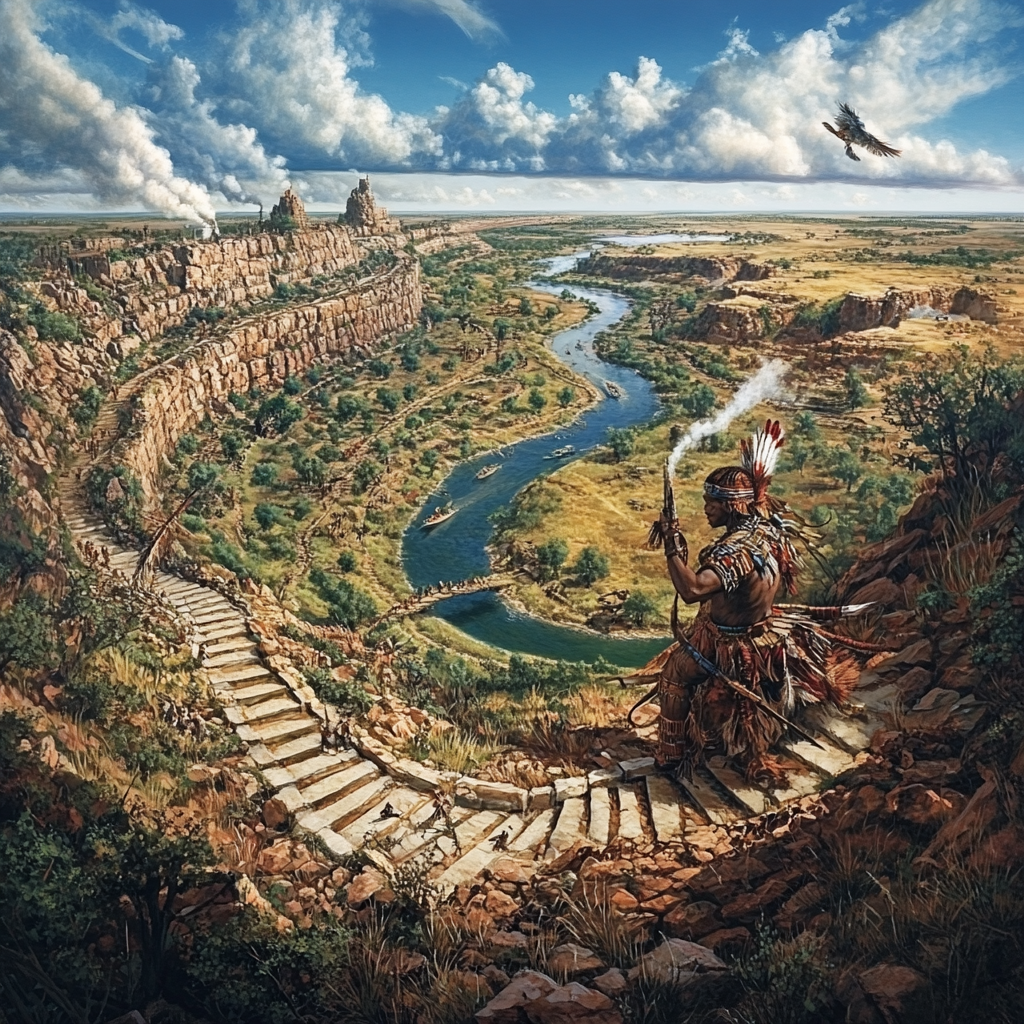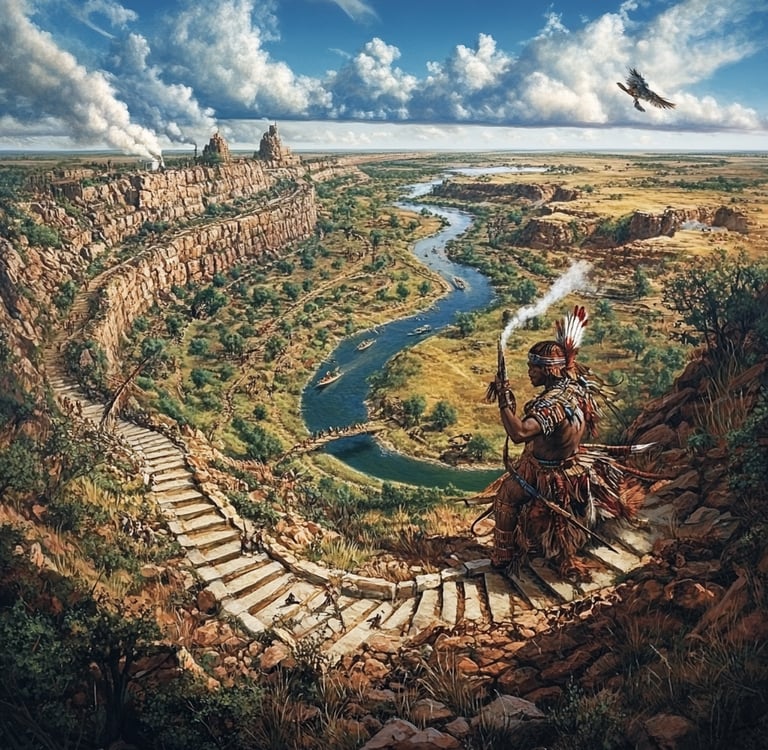

If Africa Ruled The World
What if Africa ruled the world? A question that breaks silence and rewrites history.
If Africa Ruled the World
I. The Dare Behind the Question
What if Africa had ruled the world?
This is not a thought experiment. It is not a TED Talk title or a slogan stitched onto borrowed hope. It is a counter-spell, spoken directly at the erasure, the mockery, the silence, the centuries of gaslighting dressed as scholarship.
It is what you say when you are finished being asked to feel grateful for your own disappearance.
If Africa ruled the world is the phrase that erupts from the throat of a broken timeline. It is what a child reaches for in the moment they understand their ancestors were not lost but taken. It is the question that exposes the true scale of the theft: not only of people, but of blueprints, philosophies, governance systems, sciences, mathematics, deities, and entire architectures of imagining the future.
This is not fantasy. It is reckoning. It is what happens when a child starts to realise they are part of the wonders of the world and that they came from the people that conceived, created, named and framed them. It is a reclamation of identity, and a restoration of empirical evidence of history.
Because when they say, look at how broken Africa is now, they never say who broke it. When they say, be grateful the British came, they never name what the British removed from the room before they invited you to sit at the table. This is a refusal of the inheritance of trauma as the only inheritance available to the Black world. It refuses the grammar in which African histories are mythologies and European histories are facts. And it refuses, again and again, to teach young people that the best they can ever be is an exception to their own lineage.
Africans and the African-descended, are not exceptions. They are continuity. They are the descendants of systems so sophisticated that even five centuries of organised destruction could not fully dismantle them.
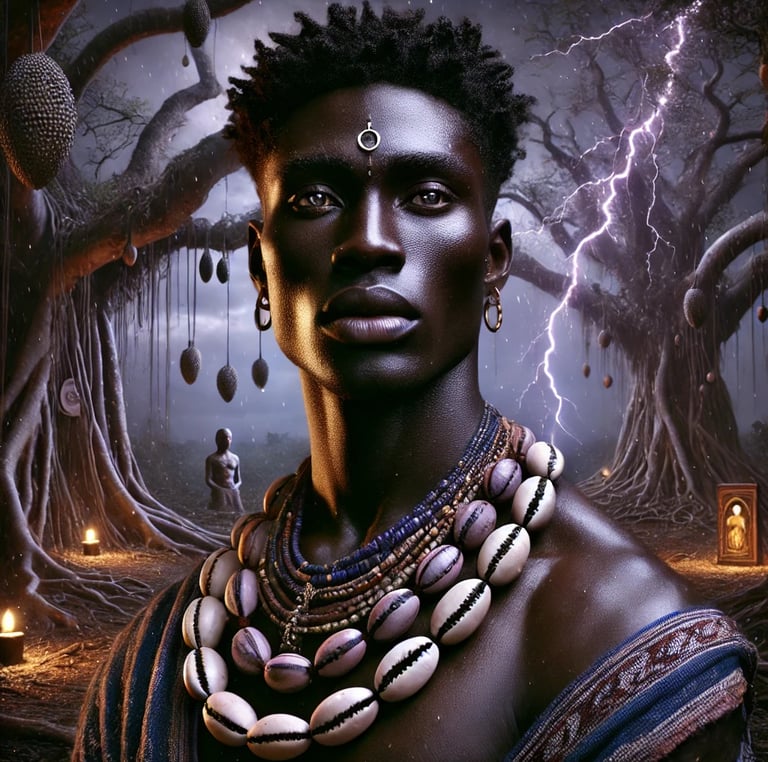
II. What This Is For
This is the anchoring portal for a sweeping new canon of African mythology, and yet it does not only tell stories. It restores systems.
Each essay gathered beneath this codex connects to one of the major mytho-historical sequences being developed across AfricanMythology.com. These are not stories of Africa as exotic backdrop, nor as the perpetual site of colonial wound. They are recoveries: of what Africa was before the edit, what it contributed to the civilisational record, and what the world might still learn if it stopped treating African knowledge as folk memory rather than a very real operational intelligence.
Three questions run beneath all of them like a river under stone. What did African civilisations already solve, long before Europe arrived with answers to questions it had not thought to ask? What did the modern world deliberately unlearn in order to justify its dominance? And what might our institutions, our governance, our medicine, our mathematics, our ethics look like today, had they evolved from African blueprints rather than worked to erase them?
These are not rhetorical questions. They are the foundation of a body of work built to establish African mythology as a legitimate academic discipline, one worthy of the same rigour, institutional gravity, and canonical authority as Classical Studies. The essays here are invitations into that seriousness. They are also, for those who lead, teach, programme, speak, and commission, a record of what has been missing and what, with sufficient courage, might now be restored.
III. It Already Happened
This is the part they never taught.
Not the hypothetical. Not the imagined. The actual record of where African civilisations were not merely surviving but setting the terms by which the world operated. Where African peoples were not subjects of history but its architects. Where the question if Africa ruled the world is answered not by speculation but by the archaeological record, the manuscript libraries, the stone cities, the hydraulic systems, and the eyewitness accounts of stunned European visitors who saw what they were never supposed to see.
The Moors in Spain: Eight Centuries of African Rule in Europe
Begin in Andalucia, because that is where the proof is most uncomfortable for Europe to carry. For eight centuries, from 711 to 1492, the most sophisticated civilisation on the European continent was African. The Almoravid and Almohad dynasties, whose rulers commanded empires stretching from the Songhai in the south to Granada in the north, built what visitors still travel to see: the Alhambra's muqarnas, the honeycomb vaulting engineered to amplify the human voice without echo; the geometric tilework following mathematical principles developed in Timbuktu and transmitted across trans-Saharan networks; the water systems that carried mountain springs through courtyards and gardens using hydraulic engineering perfected in Marrakech. When Isabella and Ferdinand destroyed Granada in 1492, they were not expelling a religion. They were ending eight centuries of African governance in Europe. What Europe calls Moorish architecture is African genius, rebadged into acceptability.
Read the full account: The Moors Codex — African Rule in Medieval Europe
Kemet: Ancient Egypt Was African
Go further back and stand in Kemet, which is to say ancient Egypt, which is to say one of the most enduring and sophisticated civilisations the world has ever produced, which was Black and African across its foundational dynasties and again under the 25th, the Nubian pharaohs who came north and restored what had decayed. The Rhind Papyrus demonstrates a complete mathematical system at a moment when Europe was preliterate. The engineering of the pyramids involved astronomical alignments, workforce logistics, and material science that modern scholarship has spent two centuries failing to fully account for. Egyptology as a discipline was constructed largely to sever this achievement from its African origin. The effort required was considerable and it was never quite enough.
Read the full account: UnBlacking Africa — How Kemet Was Stolen from the Continent
Timbuktu and the Songhai Empire
The Songhai Empire at its height in the fifteenth and sixteenth centuries controlled the trans-Saharan trade routes, administered a civil service, and housed in Timbuktu a city of a hundred thousand people and a university whose scholars produced seven hundred thousand manuscripts covering astronomy, medicine, mathematics, law, and theology. These were not oral traditions waiting to be written down. They were written, catalogued, argued over, and taught in lecture halls at a moment when Europe was burning books and burning the people who wrote them. The manuscripts survive. The argument that Africa had no intellectual tradition does not.
Read the full account: Timbuktu — Africa's City of Light
Great Zimbabwe: Who Really Built It
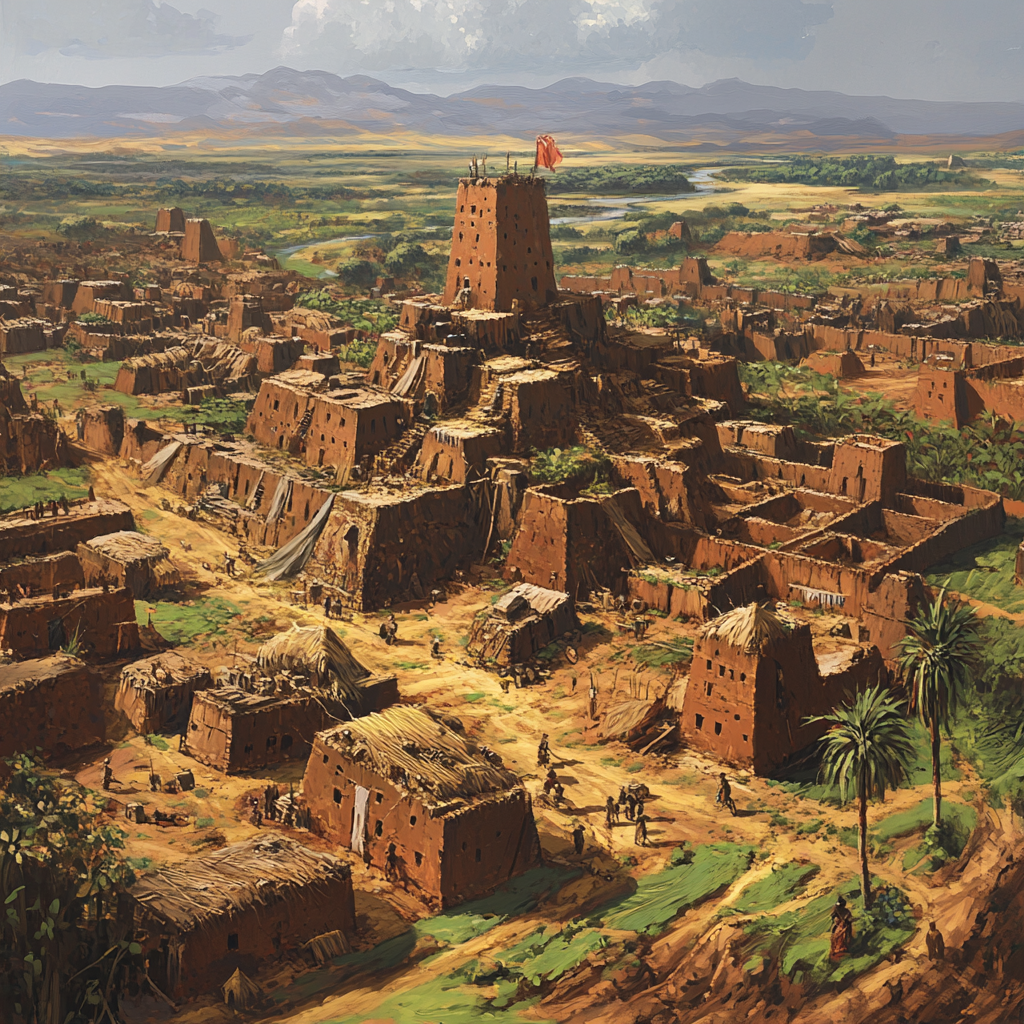
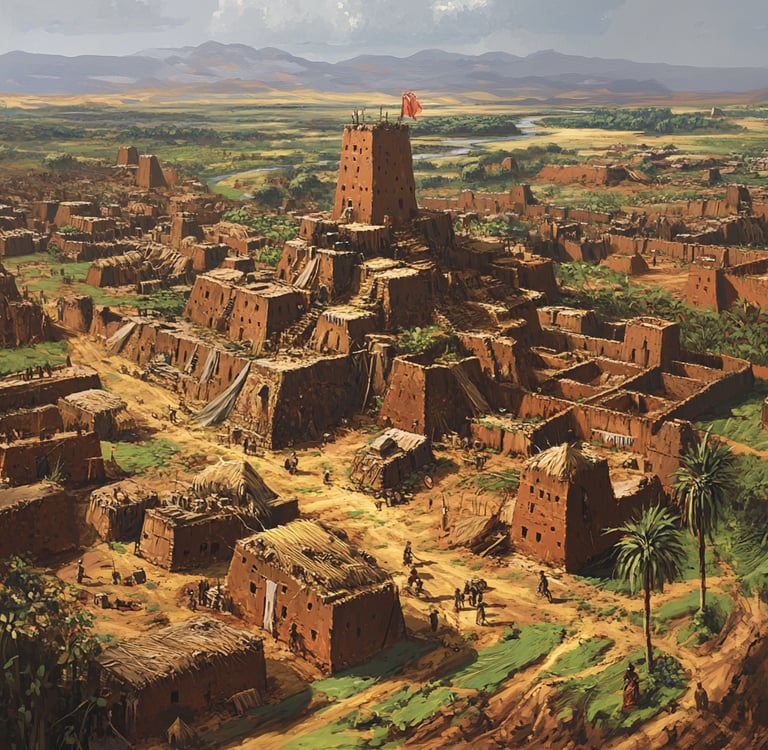
Move south and find Great Zimbabwe, a city of eighteen thousand people enclosed in walls standing eight hundred years without mortar, their courses of granite laid with such precision that the joins remain tight to this day. When European colonists encountered it in the nineteenth century, they attributed it to Phoenicians, to Arabs, to a lost white civilisation, to anyone except the Bantu builders whose descendants live nearby and always knew the truth. The misattribution was not confusion. It was policy. A civilisation that could build at that scale could not be permitted to be African, because if it was African, the entire justification for colonialism collapsed. The walls are still standing. The justification is not.
Read the full account: Great Zimbabwe — The City They Refused to See
Aksum: Africa's Forgotten World Power
Find Aksum in northern Ethiopia, one of the four great powers of the ancient world alongside Rome, Persia, and China, producing the Ge'ez script still in liturgical use today, minting its own coinage, raising obelisks cut from single pieces of granite and transported miles from their quarries by methods that remain incompletely understood. Aksum controlled the Red Sea trade routes and corresponded with Constantinople as an equal. One of its obelisks was looted by Mussolini in 1937 and only returned to Ethiopia in 2008. The looting was an acknowledgement of worth. The silence in the history books was an acknowledgement of threat.
Read the full account: Aksum — The Empire the World Forgot
The Swahili Coast: Africa's Ocean Empire
Follow the Indian Ocean south and find the Swahili Coast at its height, a thousand miles of city-states from Mogadishu to Sofala, building in coral stone, trading gold and ivory with Arabia, India, and China, navigating the open ocean with astronomical precision. These were not outposts. They were cosmopolitan centres whose merchants carried African goods to markets across the known world and returned with porcelain, silk, and spices. The interconnection was African-led, African-financed, and African-navigated. The Indian Ocean was, for several centuries, an African sea.
Read the full account: The Swahili Coast — Africa's Ocean Empire
Benin City: The Capital Europe Burned
Go west and find Benin City, whose surrounding walls extended sixteen thousand kilometres, four times the length of the Great Wall of China, surrounding a city so ordered, so vast, and so refined that the first Portuguese visitors in the fifteenth century struggled to find European equivalents for what they were seeing. The bronze castings produced in Benin were technically and artistically equal to anything being produced anywhere in the world at that moment. The British burned the city in 1897. They looted everything they could carry and left the walls to the forest. The Benin Bronzes are in London, Berlin, and Vienna. The walls are overgrown. This was not neglect. It was the deliberate erasure of evidence.
Read the full account: Benin City — The Capital They Burned
IV. What the Record Proves
These are not exceptional moments in an otherwise undistinguished history. They are points on a map of a continent building, governing, trading, philosophising, and creating at the highest levels of human civilisation across thousands of years, simultaneously, continuously, without interruption until the interruption was forced upon them from outside.
The Moors governed Europe for eight centuries. Kemet built a civilisation that lasted three thousand years. Timbuktu housed scholars when London had no universities. Great Zimbabwe engineered in stone without mortar. Aksum traded as an equal with Rome. The Swahili Coast navigated the Indian Ocean. Benin cast bronze that stunned the world.
The question is not whether Africa ruled the world. The evidence answers that. The question is what becomes possible, for the children who were never taught this, for the institutions that excluded it, for the disciplines that suppressed it, when the record is finally and permanently restored. That restoration is what this canon is for. That is what we are building here.
Explore the full Afrodeities canon at afrodeities.org. Discover the mythological traditions that carried this knowledge across centuries at africanmythology.com.