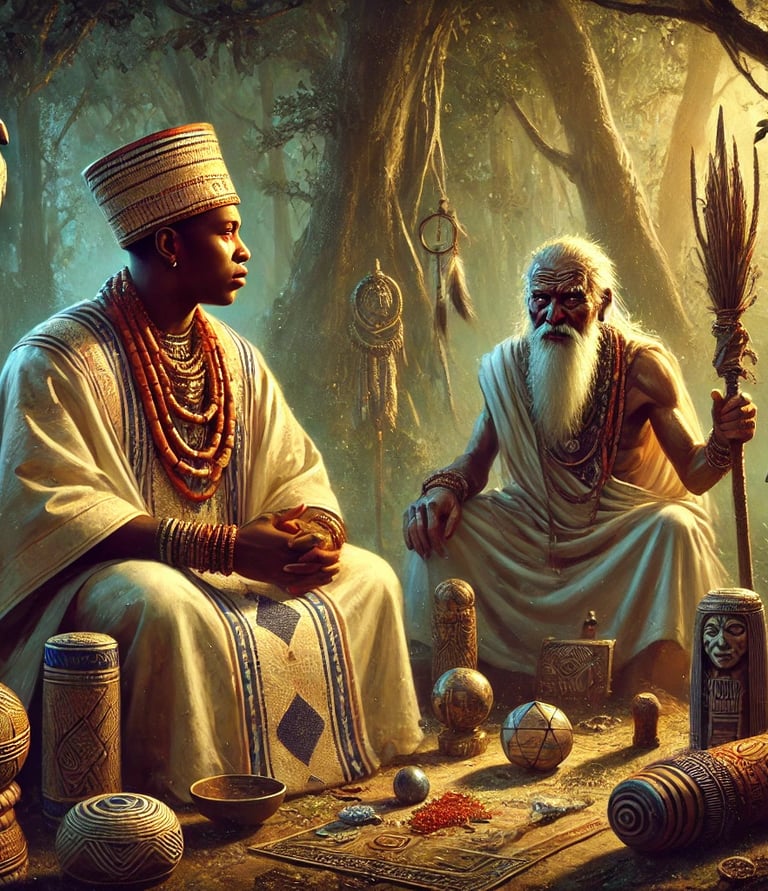
Ifa Divination - Maths not Mysticism
How Ifa’s wisdom shaped decisions beyond mere magic or mysticism
Ifa as Mathematical Architecture
At the core of Ifa lies a precise combinatorial system.
Ifa operates through 256 fundamental patterns, known as Odu. These patterns are generated through binary variation—single and double marks—producing a complete decision space of possible states. This is not metaphorical. It is literal combinatorics.
The structure is mathematically exact.
Each Odu represents a configuration of forces, conditions, and likely outcomes. Together, they form a closed logical universe—finite, enumerable, and navigable. This binary architecture predates European formulations of binary logic by centuries, possibly millennia.
But unlike modern computation, Ifa did not separate calculation from meaning.
Every pattern was embedded in lived reality.
The Verse System: A Living Database
Each of the 256 Odu contains multiple ese—verses encoding precedent, consequence, and instruction. The total corpus runs into the tens or hundreds of thousands of verses.
These verses were not poetry for entertainment. They were case law, environmental records, ethical scenarios, historical analogues, and decision trees.
Together, they formed a distributed, oral database—one that could be queried through ritualised calculation and interpreted through trained expertise.
This was not randomness.
It was pattern-matching at civilisational scale.
The Babalawo: Not a Mystic, a Specialist
A Babalawo was not a prophet.
He was a knowledge specialist.
His role was closer to a systems analyst, archivist, jurist, and historian combined. He memorised thousands of verses, understood their interrelations, and learned how to map present conditions onto historical patterns embedded in the corpus.
Training took years—often decades.
Not everyone could do this. Not because of spiritual exclusivity, but because of cognitive demand. The work required extraordinary memory, interpretive discipline, ethical grounding, and social trust.
Errors mattered. Decisions affected land use, conflict resolution, inheritance, marriage, and survival.
This was not casual belief.
It was responsibility.
Decision-Making Under Uncertainty
Ifa’s true innovation was not prediction. It was probabilistic reasoning.
The system assumed uncertainty as fundamental. It did not promise certainty. Instead, it offered structured guidance based on accumulated precedent.
Consultation was iterative. Decisions were revisited as conditions changed. Past, present, and future existed in dialogue, not sequence.
In this sense, Ifa functioned as a form of temporal computation—a way to reason across time using memory as data.
This is why it sustained societies across centuries of environmental fluctuation, conflict, and change.
Why It Looked Like Magic
To an untrained observer, the process was opaque.
They saw:
Palm nuts or divining chains cast
Marks drawn in sacred powder
A verse recited from memory
Guidance that often proved accurate
What they did not see was:
The combinatorial logic
The memorised database
The pattern recognition
The environmental and social intelligence
The historical reasoning
When complex systems are invisible, results look supernatural.
Magic is often just analysis without transparency.
Encryption as Survival Strategy
Ifa did not survive by accident.
Its knowledge was deliberately encrypted in narrative, ritual, and performance. This was not deception. It was protection.
Encoding mathematical, ecological, and ethical systems in story allowed them to survive:
Persecution
Translation
Displacement
Cultural rupture
But encryption has a cost.
When outsiders encountered these systems, they extracted principles while discarding attribution. Binary logic, algorithmic thinking, and recursive systems were absorbed elsewhere, stripped of origin, and rebranded as secular discovery.
What remained was dismissed as superstition.
The Civilisational Loss
When Yoruba priests were enslaved and trafficked, entire knowledge systems were displaced or destroyed.
These were not just religious figures. They were walking universities—carrying irrigation knowledge, governance models, ethical frameworks, and temporal systems in memory.
Much of this intelligence was lost. Some was stolen. Some was metabolised elsewhere without acknowledgment.
The tragedy is not only historical. It is ongoing.
When African systems are categorised as “mythology” while their extracted principles are celebrated as innovation, theft continues through misclassification.
The Core Correction
Ifa forces a reckoning.
It shows that:
Ritual can be analytical
Myth can encode mathematics
Orality can outperform writing under certain conditions
Computation does not require machines
Intelligence is not bound to European form
Ifa was not primitive.
It was advanced.
It was not magic.
It was method.
Why This Matters Now
The modern world runs on systems that echo Ifa’s logic:
Binary computation
Algorithmic decision-making
Probabilistic forecasting
Recursive consultation
Ethical governance frameworks
Yet the source remains uncredited.
Restoring Ifa to its rightful place is not nostalgia. It is epistemic repair.
It challenges who gets to be seen as an originator of intelligence, not merely a carrier of belief.
Closing: How Ritual Became Magic
Ritual became magic when observers lost the ability—or the willingness—to understand the system beneath it.
Ifa was never irrational.
It was illegible—by design, and later by violence.
This page exists to make it legible again.
Not as mysticism.
Not as folklore.
But as one of the most sophisticated civilisational operating systems the world has ever known.


The Genius of Ifa
How African Ritual Became Misread as Magic
Introduction: The Problem With the Word “Divination”
Ifa is almost always introduced incorrectly.
It is described as divination, fortune-telling, mysticism, or spiritual belief. These labels collapse a vast, disciplined, civilisational system into spectacle. They treat outcome without structure, result without method, ritual without intelligence.
This page exists to correct that error. Ifa was not magic. It was actually infrastructure.
It was a system for decision-making under uncertainty, built on mathematics, memory, probability, ethics, and historical precedent. It functioned as governance, law, environmental management, social regulation, and temporal reasoning long before similar systems appeared elsewhere under different names.
What later observers called “magic” was simply knowledge they could not see how to read.
FAQs
What is Ifa?
Ifa is a structured system for decision-making, not magic.
Why call it divination?
The term 'divination' oversimplifies Ifa’s complex methods and purpose.
How does Ifa work?
Ifa uses mathematics, memory, probability, and ethics to guide decisions under uncertainty.
Is Ifa a religion?
No, Ifa is a civilizational system, not a spiritual belief or religion.
What was Ifa’s role?
It served as governance, law, and social regulation infrastructure.
Why is Ifa misunderstood today?
Modern views often reduce Ifa to mysticism, ignoring its disciplined, practical foundations.
"The Bridgeworks" is an original civilisational framework developed by Chinenye Egbuna Ikwuemesi within Afrodeities.
Unearthing Africa’s myths, history, and stories together.
Heritage
© 2024. All rights reserved.
© Chinenye Egbuna Ikwuemesi 2025.
All rights reserved.
The Afrodeities Codex and all associated titles, stories, characters, and mythologies are the intellectual property of the author. Unauthorized use is strictly prohibited.