
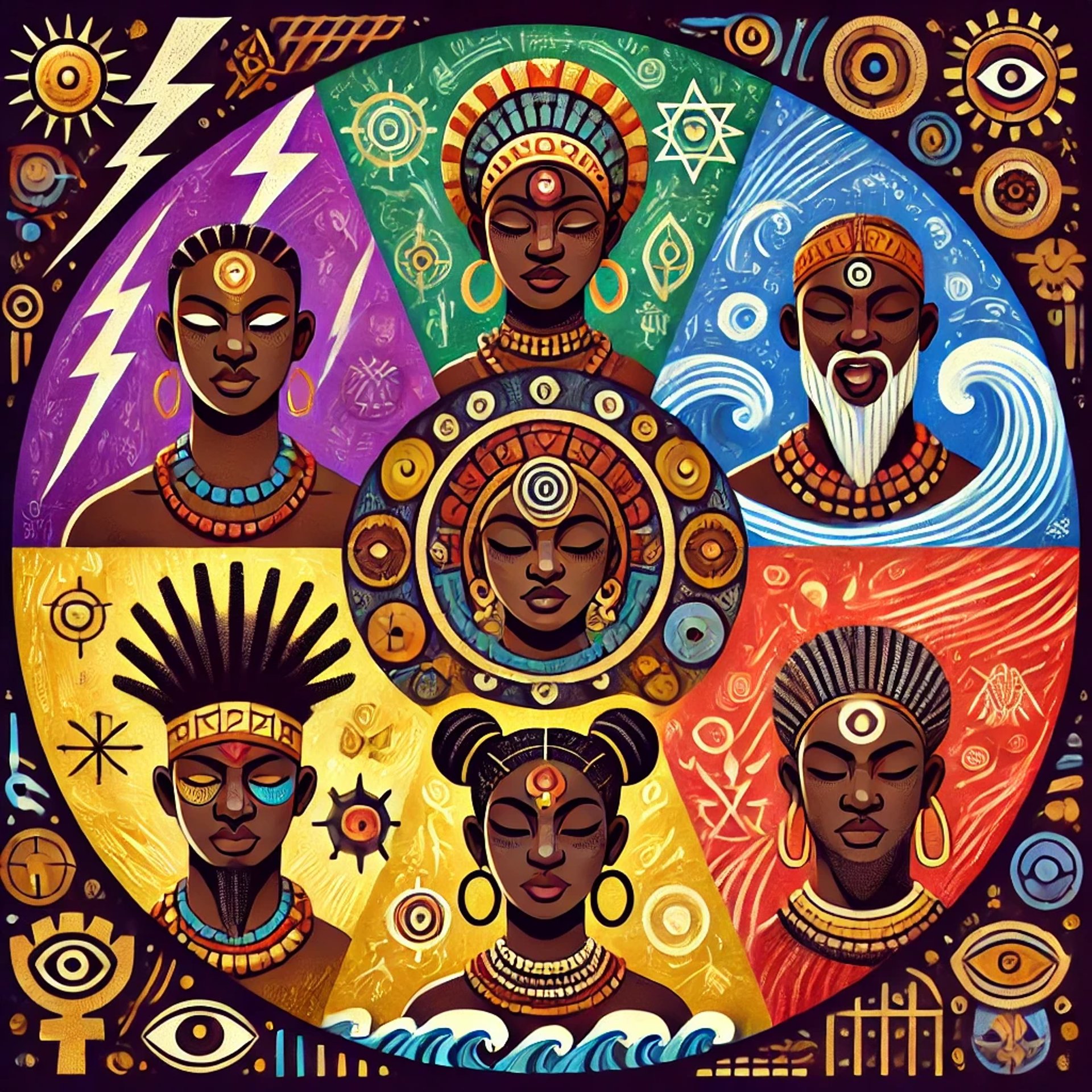
Score: Rhythm as Civilisational Memory Technology
Where rhythm and voice weave through daily life, shaping community and memory.
Introduction
Score names the African civilisational technology through which memory, identity, emotion, instruction, and future possibility are carried, felt, shared, and regenerated, before, during, and after rupture.
It is not music-as-entertainment alone. It is rhythm operating as infrastructure. Sound functioning as governance, coordination, memory storage, psychological regulation, and prophetic utterance. Rhythm imprinting knowledge into bodies so that civilisation persists when visible archives are attacked, languages disrupted, and institutions dismantled.
Score was not invented in response to rupture. It existed long before enslavement, colonisation, or displacement. Rupture simply revealed what African civilisations already knew: that knowledge stored in rhythm cannot be confiscated without killing the carrier.
Why Score is Consequential for Africans and the World
Modern historiography privileges written archives, institutional continuity, and linear chronology as proof of civilisation. These standards were not neutral. They were designed within systems that systematically dismantled African modes of record, governance, and transmission.
When African history is assessed only by the presence of formal state archives or uninterrupted textual records, absence is misread as lack. Score corrects this misreading.
Civilisations do not rely on a single memory technology. When one mode is attacked, others carry the load.
Score exists because African knowledge systems were redundant by design. Memory was distributed across multiple registers - story, rhythm, object, land, symbol - so that no single rupture could erase the whole. Rhythm was one of the most resilient carriers. It lived in breath, movement, and collective synchronisation. It required no permission to exist.
What Score Is - and Is Not
Score is:
Rhythm operating as archive, instruction, entertainment, identity marker, prophecy, coordination, and spell
Knowledge encoded into repeatable, embodied patterns that survive displacement
A pre-existing African technology that proved its durability under rupture
The mechanism that allows story to persist beyond individual memory
Entertainment that also does civilisational work
Score is not:
Music separated from practical life
A response to trauma (it predates it)
Pre-literate improvisation
Folklore without structure
Art as mere ornament
Score is operational, intentional, and engineered for survivability.
Score in the Bridgeworks Architecture
Within the Bridgeworks, Score operates in Band I: Story into Breath, the origination and transmission layer of civilisational memory.
The directional flow proceeds as follows:
Fable → Griot → Score
Fable generates instruction. It encodes cosmology, ethics, history, and law into narrative form that can travel where direct record cannot.
Griot carries that instruction forward. Trained specialists hold knowledge through disciplined recall, public performance, communal verification, and correction across generations.
Score imprints instruction into the body and the collective. Through rhythm, repetition, pattern, and cadence, knowledge becomes durable. It transforms memory into something that can survive migration, enslavement, exile, and generational rupture without dependence on a single carrier or institution.
Together, these three establish oral intelligence as system, not absence. They demonstrate that transmission was engineered for survivability, redundancy, and correction long before the conditions that made such design necessary became visible.
Score Before Rupture
Long before colonisation, before enslavement, before exile, African societies used rhythm as social infrastructure.
Music structured labour and rest. Song encoded genealogy, law, warning, praise, and satire. Call-and-response organised community decision-making, not performance.
Rhythm synchronised bodies for farming, hunting, worship, war, and celebration. Sound was how people knew they were together.
This was not "art" in the modern Western sense—something separate from practical life, created after survival needs were met. In many African contexts, music was how life was lived. You did not consume music. You participated in it. You did not need permission or training to belong to it. You sang what you learned. You learned by being present. You passed it on by living.
Score belonged to everyone. Children absorbed it before they understood it. Elders shaped it without freezing it. The community held it, not an institution.
Entertainment was essential, not incidental. Joy, beauty, collective feeling, and emotional release were not luxuries. They were survival technologies. To dance was to reclaim the body, resist reduction to pure labour, and remember oneself as human. Rhythm allowed people to feel aligned with those experiencing the same conditions. It marked identity without needing explanation.
Score existed because African civilisations understood themselves as operating beyond mere subsistence. These were societies already concerned with meaning, beauty, belonging, and transcendence - societies functioning at the upper reaches of human need, not trapped at the base.
What Rupture Did to Score
Rupture did not invent Score. It forced Score to do more work.
When Africans were captured and transported across the Atlantic, almost everything visible was stripped away. Land, kinship systems, languages, names, instruments, and institutions were systematically attacked. Writing was forbidden. Drums were criminalised. Assembly was surveilled.
But rhythm survived, because it was already embodied, communal, portable, and regenerative.
Work songs carried timing and instruction. Spirituals carried layered meaning under theological cover. Clapping, foot-stomping, and breath replaced banned instruments. What appeared to overseers as "song" functioned as coordination, memory, warning, and emotional regulation.
Rhythm became camouflage. Music did what chains could not stop: it let people leave without leaving, feel free before freedom arrived, practice joy under surveillance.
Score was now also:
Shield – protecting identity when names were stripped
Archive – carrying memory when language was fragmented
Signal – binding people together when every other binding force was under attack
Survival technology – regulating grief, rage, fear, and hope when formal support systems were unavailable
Art remained. People still sang for joy. They still danced. They still loved beauty. But art was now also protection, preservation, and resistance. Score operated simultaneously as entertainment and infrastructure. That dual function was not compromise. It was mastery.
Score as Sigil
Score functioned - and still functions - as sigiling: the marking of presence under domination.
The rhythms were not theirs. The movements were not theirs. The sound marked difference unmistakably. Even when language fractured, rhythm cohered. Even when names were stripped, sound remembered. You heard it and knew who it was for. You heard it and knew you belonged.
Score didn't just entertain. It announced presence under conditions designed to erase it. That is sigil-work.
The fact that global culture now orients itself around Black sound is not coincidence. It is the delayed consequence of a system that could not be destroyed.
The Continuum: Africa to Diaspora and Back
Diasporic Black music is not derivative. It is continuity under pressure.
The people taken from Africa did not invent music from nothing in the Americas. They reconstituted African rhythmic intelligence under constraint. What survived was not identical to what was left behind, but it was recognisably descended from it. The logic endured even as the form adapted.
That logic is why Black American music did not remain local.
Blues reorganised sorrow into structure. Jazz introduced collective improvisation as law. Gospel fused African call-and-response with survival theology. Funk re-centred the body as authority. Hip-hop turned rhythm into archive, reportage, resistance, and future-making.
These were not accidental innovations. They were the flowering of a long-held African understanding: that rhythm can store memory, organise people, and transmit worldview without permission.
This is why Black diasporic music now defines global sound. Popular music worldwide follows structures developed by Black Americans, whose ancestors carried African rhythm through enslavement. Timing, syncopation, swing, groove, break, drop—these are not neutral musical choices. They are survivals. They are Africa, translated through rupture.
And the conversation is ongoing.
Afrobeats sends new forms into the world. Global artists respond, mutate, remix. Africa hears what came back and responds again. This is not cultural diffusion. This is call-and-response at planetary scale.
Africa → diaspora → world → Afrobeats → return.
Score is Africa's first global language—spoken in rhythm before it was ever written in words.
Score and the Black Continuum
Score is one of the clearest proofs of the Black Continuum.
Languages diverged. Geographies separated. Histories branched. But rhythmic logic remained recognisable across the Atlantic world. This continuity is structural.
Score demonstrates that African-descended peoples did not merely survive rupture - they carried systems through it. The Black Continuum becomes legible through Score, alongside Soil and Seed (ecological knowledge) and Memorabilia (material proof): rhythm, ecology, and objects functioning as distributed archives that connected disparate Black populations through shared civilisational memory.
Score's Recursive Relationship with Spell
Score does not operate in isolation. It moves forward into Spell, the next function in the Bridgeworks directional flow.
Rhythm structures incantation. Sound gives form to performative utterance. What is encoded in Score becomes enacted through Spell. This is why music was often inseparable from ritual, why songs carried consequences, why certain rhythms were forbidden or sacred.
Spell depends on Score to provide the pattern through which meaning is fixed and effect is produced. Without rhythm, spell loses its precision. Without repetition, incantation cannot bind. Score is the infrastructure upon which performative knowledge operates.
This recursive relationship demonstrates that the Bridgeworks is not a catalogue but a system. Knowledge moves through multiple states, each reinforcing the others.
Why Score Matters Now
Score matters because modern systems are once again fragile.
Digital archives disappear. Institutions fail. Truth is manipulated. Surveillance saturates. Psychological fragmentation accelerates.
Score reminds us that:
Knowledge does not require permission to endure
Memory can live outside official systems
The body remains a viable archive
Collective rhythm resists isolation and fragmentation
Joy and beauty are not luxuries—they are survival technologies
This is not nostalgia. It is strategy.
African civilisations anticipated conditions of rupture and designed knowledge systems capable of surviving them. The modern world is now entering similar conditions: system failure, institutional distrust, information overload, surveillance saturation, psychological fragmentation.
Score becomes relevant again because it teaches how to coordinate without central authority, how to encode ethics without enforcement, how to move meaning through hostile systems, and how to preserve humanity under pressure.
Score as Load-Bearing Span
Within the Bridgeworks, Score may be the load-bearing span.
It holds Fable (instruction through story), because story can be sung when it cannot be spoken. It carries Griot (the historian-musician), because the keeper of memory becomes the maker of rhythm. It operates as Spell (performative knowledge that produces effect). It marks identity like Sigil (presence under pressure). It stores memory like Script (record, lineage, and event encoded in verse). It contains Memorabilia (melody as memory with muscle). It germinates futures like Seed (music as rehearsal for what has not yet arrived).
Score is not supplemental. It is the bloodstream. Everything else either enters through it or emerges from it.
That does not diminish the other functions. It explains how they survived long enough to still exist.
What Score Ultimately Proves
Score proves that African civilisations did not lose knowledge when archives were destroyed. They changed storage formats.
African culture was never fragile. It was designed to move, change, and return.
Score is art. Score is memory. Score is survival. Score is identity. Score is prophecy. Score is entertainment. Score is infrastructure.
And crucially, Score proves something the world still struggles to admit: Africa has never stopped speaking. The world has simply been dancing to it without always knowing why.
Where the Deeper Work Lives
This page establishes Score within the Bridgeworks architecture. The full theory, history, sonic analysis, and cultural genealogy live in The Book of Superscore, part of the Afrodeities Codex.
For those seeking deeper engagement with how rhythm functions as civilisational technology, how African musical systems predate and inform global genres, and how Score operates across the Black Continuum, that volume provides comprehensive treatment.
This page names the architecture. The book inhabits it.


Music here feels like home.
"
FAQs
What is Score?
Score is the African civilisational technology through which memory, instruction, emotion, and identity are encoded into rhythm and carried forward across time, displacement, and rupture.
Is Score just music?
No. Score includes music, but it is rhythm operating as archive, coordination, identity marker, entertainment, instruction, and survival technology. Music is one expression of Score, not its totality.
Did Score exist before slavery?
Yes. Score existed in pre-colonial African societies as social infrastructure. Rupture did not invent Score. It forced Score to do additional work under constraint.
How does Score relate to the Bridgeworks?
Score operates in Band I (Story into Breath) alongside Fable and Griot. It imprints instruction into the body so knowledge survives beyond individual carriers. It also has a recursive relationship with Spell in Band II.
Why does Score matter for the diaspora?
Score explains how African rhythmic systems survived enslavement and reappeared across the Black world. It connects jazz, blues, gospel, hip-hop, and Afrobeats back to African civilisational logic, showing continuity rather than coincidence.
What is the relationship between Score and the Black Continuum?
Score is one of the clearest proofs of the Black Continuum. Despite divergent languages and histories, rhythmic logic remained recognisable across the Atlantic world, demonstrating that African-descended peoples carried systems, not just culture, through rupture.
"The Bridgeworks" is an original civilisational framework developed by Chinenye Egbuna Ikwuemesi within Afrodeities, for historical repair, continuity, and truth-telling across Africa and the Black world.
"The Bridgeworks" is an original civilisational framework developed by Chinenye Egbuna Ikwuemesi within Afrodeities.
Unearthing Africa’s myths, history, and stories together.
© 2024. All rights reserved.
© Chinenye Egbuna Ikwuemesi 2025.
All rights reserved.
The Afrodeities Codex and all associated titles, stories, characters, and mythologies are the intellectual property of the author. Unauthorized use is strictly prohibited.
Goddesses