
Who is Mami Wata? The Enigmatic Mermaid Water Spirit of African Mythology
Dive into the mesmerizing world of Mami Wata, the powerful and mysterious water spirit revered across Africa and the African diaspora. Often depicted as a stunning mermaid-like figure, Mami Wata embodies seduction, wealth, mysticism, and duality—she is both a giver of blessings and a force of reckoning. In this deep exploration, we uncover Mami Wata's origins across various cultures, from the Igbo Uhamiri to the Afro-Caribbean Lasiren, and reveal how she continues to shape spiritual practices today. From her serpent-and-mirror symbols to her role in traditional healing, business prosperity, and personal transformation, Mami Wata's presence remains as potent as ever. Whether through Afrofuturism, modern fashion, or spiritual revival, this water deity continues to captivate and challenge us, reminding us of the enduring strength of African mythology. Discover why Mami Wata still reigns over the depths and hearts of those who seek her mysteries.
Chinenye Egbuna Ikwuemesi
2/5/20253 min read
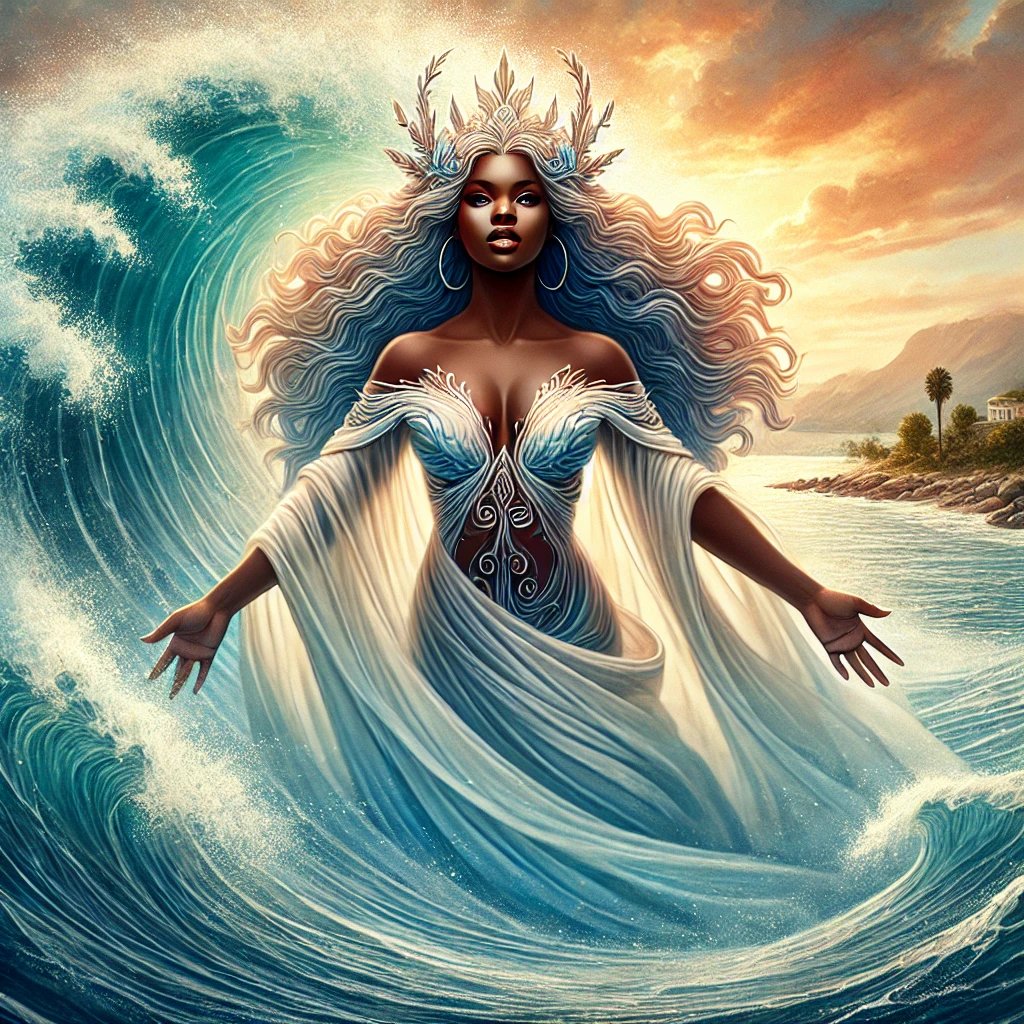

Mami Wata: Archival Survival and the Black Continuum
Mami Wata is not a figure of folklore. She is evidence.
Evidence of a coherent precolonial cosmology that travelled across the Atlantic under the most violent conditions imaginable, fractured, adapted, took new names in new languages, and survived. When you encounter her in Haitian Vodou as Lasiren, in Cuban and Brazilian Candomble as Yemaya, in West African riverine traditions as Uhamiri and Ogbuide, you are not looking at separate myths that happen to resemble each other. You are looking at one spiritual technology that refused to be destroyed.
That is the correct frame for understanding Mami Wata. Not curiosity. Civilisational continuity.
She is a water spirit, or more precisely a class of water spirits, found across West, Central, and Southern Africa and throughout the diaspora. Her name means Mother of Waters. Among the Igbo of Nigeria she is Uhamiri, the goddess of the River Niger, granting wealth and wisdom to those who honour her. Among the Ewe and Fon peoples of Benin, Togo, and Ghana she governs the flow of life, fertility, and oceanic abundance. In Sierra Leone and Liberia, fishermen and traders have sought her favour for safe passage across water. Her names change by region. Her function does not.
She is typically depicted as a woman of striking beauty, sometimes with a serpent coiled around her, sometimes as a half-human, half-fish figure. Her symbols are mirrors, water, serpents, and the colours red and white. She represents seduction and power, wealth and its obligations, mysticism and the duality that runs through all serious engagement with the divine. She gives. She takes. She tests. Those who receive her blessings and fail in loyalty discover what the taking looks like.
What happened to Mami Wata across the Middle Passage is one of the most instructive cases in the study of how African knowledge systems survived displacement. She did not survive by staying intact. She survived by being carried in the bodies and memories of enslaved people and adapting to every context she arrived in without losing her essential logic. Lasiren in Haiti is recognisably Mami Wata. Yemaya in Santeria and Candomble is recognisably Mami Wata. The African American hoodoo traditions that invoke a spirit of luck, sensuality, and transformation are working within the same current.
This is what the Afrodeities Institute means by the Black Continuum. The thread is not broken. It is bent, extended, translated, sometimes almost invisible. But it runs without interruption from the rivers of West Africa through the holds of slave ships to the ceremonies of the Caribbean and the Americas and back again. Mami Wata did not cross the Atlantic. She was carried across it. There is a difference. One implies voluntary movement. The other implies what actually happened, and the extraordinary fact that the knowledge survived it.
Worship of Mami Wata takes place at bodies of water. Offerings include perfumes, mirrors, white cloth, fresh fruit, and libations. Devotees may enter trance states during ceremonies. Priestesses and priests guide initiates through rituals of purification and offering. Those chosen by Mami Wata are said to experience visions, strange dreams, sometimes near-drowning, the boundary between her world and the living one made briefly permeable.
In contemporary culture she appears in Afrofuturism, in fashion, in music, in the visual arts of the diaspora. Her image as a powerful Black mermaid challenges centuries of European iconography that placed the feminine divine in exclusively Western forms. That reclamation is not superficial. It is part of the same project that produced the ceremonies, the offerings, the initiations. The form changes. The insistence on African spiritual presence does not.
Mami Wata endures because she was never just a story. She was a system. Systems that are built with sufficient coherence and carried with sufficient devotion do not disappear when the conditions around them become hostile. They adapt. They surface in new forms. They wait.
She is still waiting. And she is still here.