
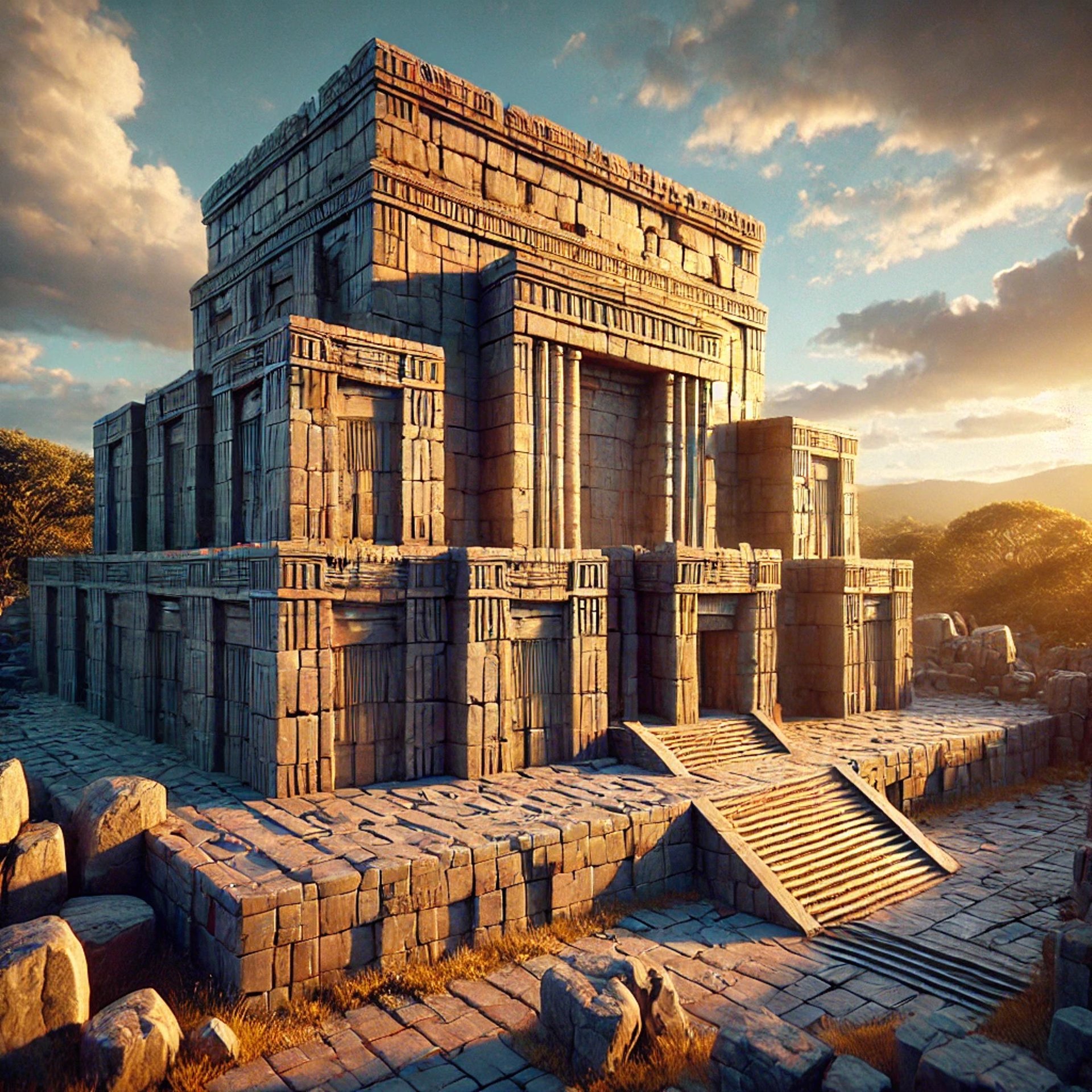
Great Zimbabwe: Who Really Built It
Eight centuries of stone walls, built by the Shona ancestors nearby.
Who Built Great Zimbabwe?
by Chinenye Egbuna Ikwuemesi
The walls have been standing for eight hundred years. They were built without mortar, the granite courses laid with a precision so exact that the joins remain tight against wind and rain across eight centuries, and they were built by the ancestors of the Shona people of present-day Zimbabwe, whose descendants live nearby and have always known this. The walls themselves are not the mystery. The mystery is why the question of who built them was ever considered mysterious at all.
Great Zimbabwe is the largest stone structure in sub-Saharan Africa. Its Great Enclosure, whose outer wall stands eleven metres high and stretches two hundred and fifty metres in circumference, was constructed from an estimated nine hundred thousand granite blocks, each one shaped to fit its neighbour without adhesive, following a technique of dry stone masonry that represents the accumulated expertise of skilled builders working within a tradition that had developed over generations. The city it enclosed housed, at its height in the fourteenth century, a population estimated at between 11,000 and 18,000 people. It was the capital of a kingdom that controlled the gold trade between the interior of southern Africa and the Swahili Coast, growing wealthy enough to import Chinese porcelain, Persian ceramics, and Arabian glass, fragments of all of which archaeologists have recovered from the site.
This was not a settlement. It was a capital. And when Europeans first encountered it, they refused to believe that Africans had built it.
The Archaeology of Denial
The first European account of Great Zimbabwe comes from the Portuguese trader João de Barros, who recorded its existence in 1531 from the reports of African traders, describing it as a fortress of stone whose blocks were joined without mortar, so well fitted that no cement was visible between them. The Portuguese did not claim to know who had built it. They simply recorded what they had been told.
The problem came later, when the British South Africa Company took control of the region in the 1890s and the question of Great Zimbabwe's origins became politically urgent. The Rhodesian colonial project depended on the theory that the region had no significant pre-colonial African civilisation, that the land the settlers were occupying had been essentially empty of history before their arrival. A stone city of nine hundred thousand blocks, containing the evidence of a sophisticated state that had traded across the Indian Ocean for centuries, was an inconvenient fact.
The colonial response was systematic. The first European archaeologist employed to investigate the site, J. Theodore Bent, arrived in 1891 with the explicit brief from the British South Africa Company to find evidence of non-African origins. He found none, but published conclusions that suggested Phoenician or Arabian builders anyway. His successor, Richard Nicklin Hall, who was employed as the curator of the site from 1902, actively destroyed archaeological layers in his search for evidence of foreign construction, digging through stratified deposits that might have answered questions about the site's development and discarding the material. He published a book attributing the ruins to Arab builders.
The archaeologist who did the definitive work, David Randall-MacIver, arrived in 1905 and found that the evidence pointed unambiguously to African builders of medieval date. He said so clearly. The colonial authorities and the settler press attacked him vigorously. Gertrude Caton-Thompson confirmed his conclusions in 1929 after further excavation, and was similarly attacked. The argument was not about evidence. It was about what the evidence was permitted to mean.
What the City Actually Was
Great Zimbabwe was the capital of the Kingdom of Zimbabwe, a state that controlled the gold and ivory trade between the interior plateau of southern Africa and the trading cities of the Swahili Coast from roughly the eleventh to the fifteenth century. Its rulers, known as the Mambo, governed a territory that stretched across much of present-day Zimbabwe and Mozambique. The city's wealth is evident in the imported goods found in its deposits, the Chinese porcelain of the Song and Ming dynasties, the Islamic glassware, the conus shell ornaments from the Indian Ocean coast, the gold objects of extraordinary refinement.
The gold came from mines across the plateau, worked by communities under the authority of the Zimbabwe state, processed and traded through a network of tributary relationships that the capital managed and profited from. This was not a simple chiefdom. It was a state with a defined territory, a capital city, a surplus-extracting economic system, and the architectural ambition to build in permanent stone on a scale that announced its power across the landscape.
The iconic conical tower within the Great Enclosure, a solid stone tower roughly ten metres high whose purpose remains debated but whose craftsmanship is extraordinary, is the kind of monument that states build when they want to make their permanence visible. It is a statement in stone: we are here, we have always been here, and we intend to remain.
The Continuing Misattribution
Zimbabwe achieved independence in 1980 and took its name from the ruins, a direct assertion that the civilisation the ruins represent belongs to the nation that inherited the land. The apartheid regime in neighbouring South Africa continued to publish school textbooks claiming non-African origins for Great Zimbabwe into the 1980s. The academic debate was, in professional archaeology, long settled by then. The popular misunderstanding persists because popular culture draws from a reservoir filled during the colonial period and imperfectly drained since.
The ancestors of the Shona built Great Zimbabwe. The evidence is in the stone, in the pottery sequence, in the oral traditions of the Shona people themselves, in the DNA of the population that has always lived in the surrounding region. The mystery was never archaeological. It was ideological. And ideologies, unlike walls, do not always hold their shape across centuries.
The walls remain. Dry-laid, unmortared, eight hundred years and standing. They were always African. They were always the answer.
This article is part of the If Africa Ruled The World codex, a canon of corrective African civilisational history developed by the Afrodeities Institute. Chinenye Egbuna Ikwuemesi is a mythologist, scholar, and author of Nigerian Mythology: The Shadow Sky. Enquiries from editors, programmers, and conference organisers are welcome at afrodeities.org.
Related reading: Benin City: The Capital Europe Burned. The Swahili Coast: Africa's Ocean Empire.
"The Bridgeworks" is an original civilisational framework developed by Chinenye Egbuna Ikwuemesi within Afrodeities.
Unearthing Africa’s myths, history, and stories together.
© 2024. All rights reserved.
© Chinenye Egbuna Ikwuemesi 2025.
All rights reserved.
The Afrodeities Codex and all associated titles, stories, characters, and mythologies are the intellectual property of the author. Unauthorized use is strictly prohibited.
Goddesses