
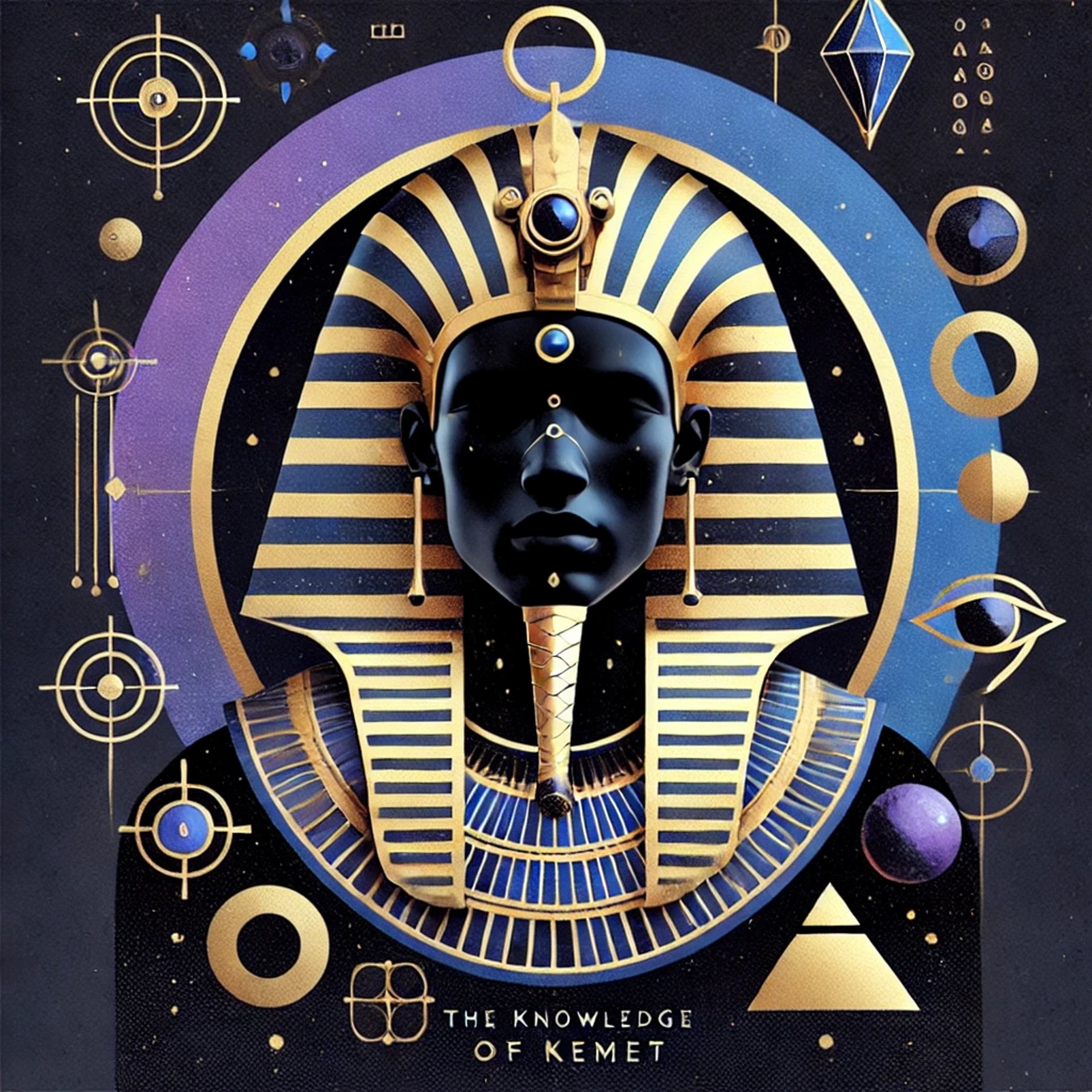
Kemet: Ancient Egypt Was African
Unveiling the African roots behind ancient Egypt’s enduring legacy
Who Were They?
by Chinenye Egbuna Ikwuemesi
The discipline of Egyptology was built on a question it could never quite bring itself to answer honestly.
Who were these people?
The monuments were undeniable. The mathematics was extraordinary. The longevity of the civilisation, three thousand years of continuous development, dwarfed anything Europe had produced or would produce. And the people who built it, whose faces look out from tomb paintings, whose mummified remains carry the physical evidence of their origins, whose own records name their southern neighbours as their ancestors, were African.
Egyptology's foundational project, from its formalisation in the nineteenth century onward, was to make that fact navigable for a European intellectual establishment that had staked its theory of civilisation on African incapacity. The result was a discipline that could speak at extraordinary length about ancient Egypt while systematically avoiding the most obvious thing about it.
What Kemet Was
The people of ancient Egypt called their land Kemet, the black land, a name that referred to the fertile dark soil of the Nile Valley but that carried, as names in African traditions invariably do, multiple registers of meaning. They called themselves the people of the black land. Their civilisation emerges from the Nile Valley, which is to say from the African continent, drawing on traditions of agriculture, astronomy, governance, and spiritual practice that developed across the Saharan and sub-Saharan regions over thousands of years before the first dynastic period.
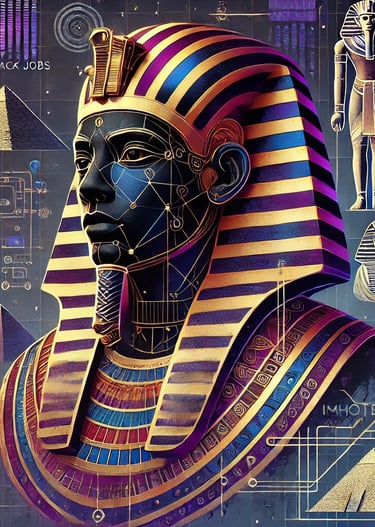
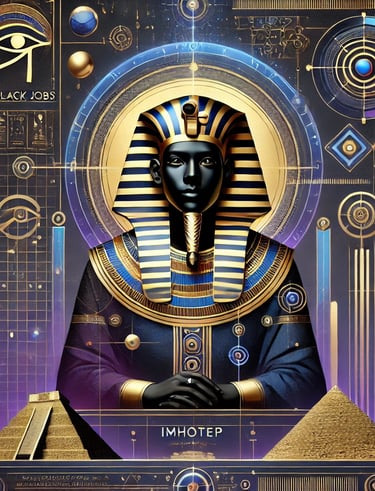
The connections between Kemet and its African neighbours were not peripheral. They were foundational. The 25th Dynasty, the Nubian pharaohs who came north from the Kingdom of Kush in present-day Sudan and ruled Egypt from around 747 to 656 BCE, were not foreigners restoring order to a foreign land. They were returning cousins, deeply versed in Kemetic tradition, who revived practices and artistic forms that the preceding dynasties had allowed to decay. Pharaoh Taharka, one of the 25th Dynasty's greatest rulers, is mentioned in the Bible and commanded an empire that stretched from the confluence of the Nile to the borders of Asia. His face, on the monuments he built, is the face of a Black African man. This is not interpretation. It is what the stone shows.
The Mathematics and the Monuments
The Rhind Mathematical Papyrus, dating to around 1550 BCE but drawing on sources several centuries older, demonstrates a complete and sophisticated mathematical system at a moment when the civilisations of Europe were preliterate. It contains methods for calculating the area of a circle, the volume of a cylinder, the slopes of pyramids. It works with fractions of a complexity that European mathematics would not match for another thousand years. It is an Egyptian document. It is an African document. These are the same statement.
The engineering of the pyramids has generated enough speculation to fill libraries, most of it devoted to avoiding the obvious conclusion that Africans built them. The logistics required to quarry, transport, and position millions of stone blocks to tolerances that modern engineering respects are the logistics of a sophisticated state with advanced mathematical knowledge, organisational capacity, and accumulated technical expertise. The workers who built the pyramids were not slaves, as nineteenth-century mythology insisted. Archaeological evidence from the workers' village at Giza shows skilled labourers who received medical care, ate well, and were buried with honours. They were professionals. They were African professionals building for an African civilisation.
How Egyptology Severed Egypt from Africa
The techniques of separation were multiple and mutually reinforcing. Geographical: Egypt was placed in the Near East, the Middle East, the Mediterranean world, anywhere but the African continent it physically occupies. Racial: the ancient Egyptians were described as Caucasian, Semitic, Mediterranean, a separate race from the sub-Saharan Africans to their south, a categorisation that required the invention of both sub-Saharan Africa as a meaningful category and a racial boundary running somewhere through the Sahara. Linguistic: the Afroasiatic language family, which includes ancient Egyptian, was described in terms that obscured its African origins. Cultural: the connections between Kemetic religious practice and the spiritual traditions of the rest of the continent were minimised or denied.
The Hamitic hypothesis, the nineteenth-century theory that any sophisticated African civilisation must have been the work of a Caucasian or near-Caucasian Hamitic race distinct from the Black Africans around them, was not a fringe position. It was the mainstream of European anthropology and Egyptology for most of the nineteenth and twentieth centuries. It required constant adjustment as evidence contradicted it, and it was never quite abandoned even as it became academically untenable. Its ghost persists in the framing of popular Egyptology to this day.
What the Record Actually Shows
Cheikh Anta Diop, the Senegalese scholar whose work from the 1950s onward built the systematic case for ancient Egypt as a Black African civilisation, was not advancing a political argument dressed as scholarship. He was doing what the discipline had refused to do: reading the evidence. Melanin testing of mummies. Analysis of skeletal morphology. Study of the linguistic connections between ancient Egyptian and other African languages. Examination of the cultural and religious connections between Kemet and Nubia, between Egyptian cosmology and the traditions of the rest of the continent.
The 1974 UNESCO symposium on the peopling of ancient Egypt, convened specifically to address the question, reached a consensus that the ancient Egyptians were African. The consensus did not transform the discipline. The popular imagination still reaches for images of the ancient Egyptians that carefully manage their Blackness away. The film industry still casts them as ambiguously Mediterranean. The museums still frame them as a civilisation apart.
The stone does not agree. The mathematical papyri do not agree. The mummies, tested under conditions that have only become more precise over time, do not agree. Kemet was African. Its people were Black. Its achievements are the achievements of the African continent and of the African people whose descendants span the world.
That this needs to be said in the twenty-first century is not evidence of the controversy of the claim. It is evidence of the scale of the project that worked to suppress it.
This article is part of the If Africa Ruled The World codex, a canon of corrective African civilisational history developed by the Afrodeities Institute. Chinenye Egbuna Ikwuemesi is a mythologist, scholar, and author of Nigerian Mythology: The Shadow Sky. Enquiries from editors, programmers, and conference organisers are welcome at afrodeities.org.
Related reading: The Moors in Spain: Eight Centuries of African Rule in Europe. UnBlacking Africa: How the Erasure Was Engineered.
"The Bridgeworks" is an original civilisational framework developed by Chinenye Egbuna Ikwuemesi within Afrodeities.
Unearthing Africa’s myths, history, and stories together.
© 2024. All rights reserved.
© Chinenye Egbuna Ikwuemesi 2025.
All rights reserved.
The Afrodeities Codex and all associated titles, stories, characters, and mythologies are the intellectual property of the author. Unauthorized use is strictly prohibited.
Goddesses