
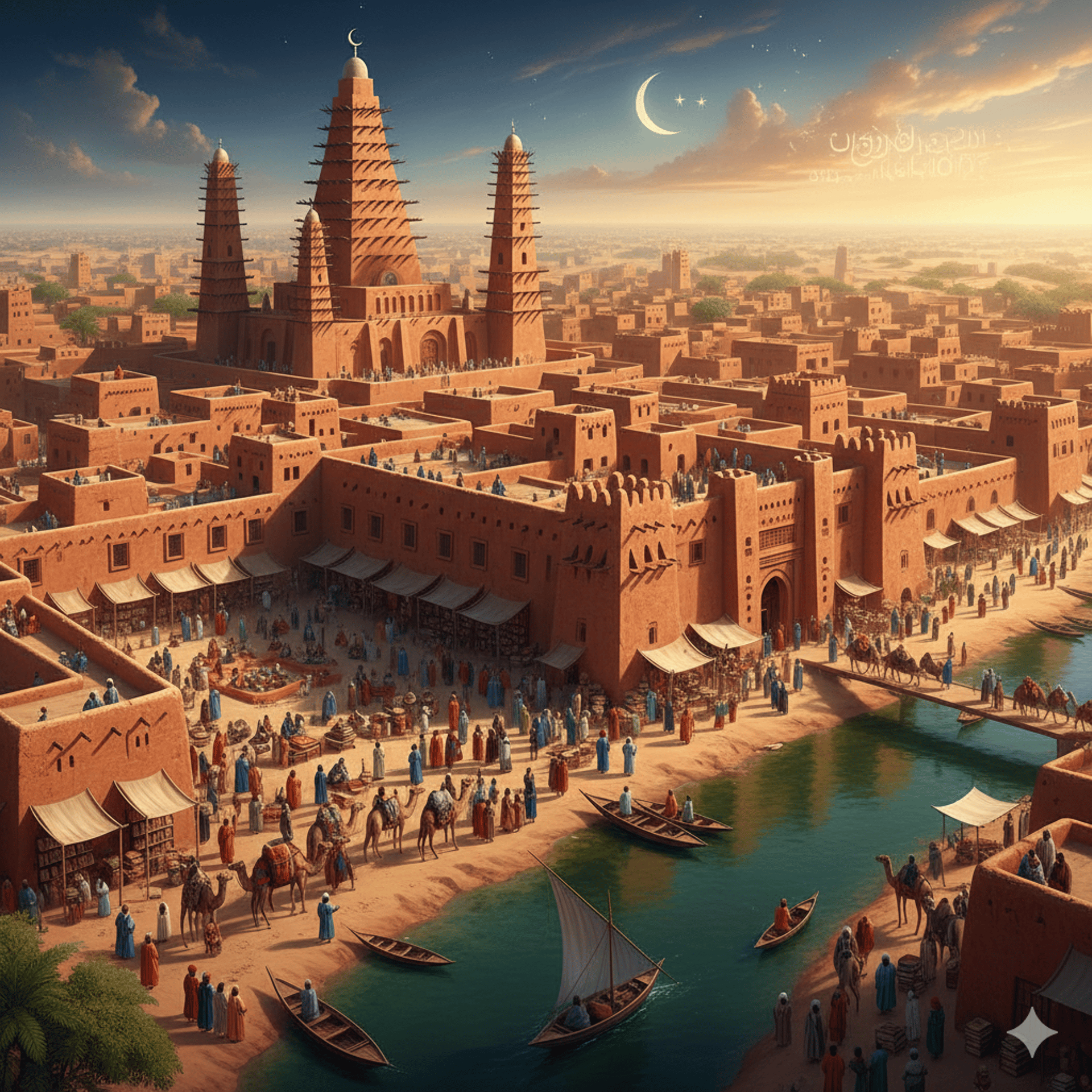
Timbuktu and the Songhai Empire: Africa's Age of Enlightenment
Before Europe's Enlightenment, Africa sparked its own age of profound knowledge and culture.
Africa's First Enlightenment
by Chinenye Egbuna Ikwuemesi
Europe has an Age of Enlightenment. It runs, in the conventional telling, from roughly the mid-seventeenth century through the eighteenth, encompassing the scientific revolution, the rise of empirical philosophy, the beginnings of democratic theory, and the expansion of literacy and print culture. It is taught as the moment when human reason came into its own, when the accumulated knowledge of centuries was systematised, debated, and made the foundation of a new kind of civilisation.
Africa had one first.
The city of Timbuktu at the height of the Songhai Empire in the fifteenth and sixteenth centuries was a centre of scholarship, legal philosophy, astronomy, medicine, and mathematics whose scale and sophistication has no honest equivalent in the Europe of the same period. It had universities. It had a book trade. It had scholars who corresponded across a network of learning that stretched from the Atlantic coast of West Africa to Cairo and beyond. It had, by conservative scholarly estimate, a population of a hundred thousand people in a city governed by codified law and administered by a professional civil service.
Europe at the same moment was burning scholars at the stake.
The Songhai Empire
The Songhai Empire, which reached its greatest extent under the rule of Askia Muhammad from 1493 to 1528, was the largest empire in African history by territorial extent, controlling the central and western Sudan across an area roughly the size of Western Europe. Its administrative system divided the empire into provinces, each governed by appointed officials who answered to the centre. Its military was professional and organised. Its taxation system was sophisticated enough to fund both state infrastructure and the institutional life of the cities it governed.
Askia Muhammad, who came to power after overthrowing the Sunni dynasty and whose reign is remembered in the oral tradition of West Africa as a golden age, was by the accounts of both African and Arab scholars of his time an administrator of exceptional ability and a patron of scholarship whose investment in the intellectual life of the empire transformed Timbuktu from a prosperous trading city into something more closely resembling a civilisational capital.
He made the pilgrimage to Mecca in 1496 with an entourage of five hundred cavalry and a thousand infantry, and distributed gold along the route in a display that impressed observers across the Islamic world. He returned with scholars, and with the formal recognition of the caliph of Egypt, who appointed him caliph of the Sudan. The pilgrimage was not merely religious. It was diplomatic and intellectual, an integration of the Songhai Empire into the wider network of Islamic scholarship that gave Timbuktu's scholars access to the full breadth of the medieval world's knowledge.
The University of Sankore
The Sankore mosque and university at its height enrolled twenty-five thousand students in a city of a hundred thousand people, a ratio that no medieval European city approached. Its curriculum encompassed Quranic studies, law, rhetoric, logic, astronomy, history, and mathematics. Its scholars held advanced degrees, the equivalent of doctorates, in multiple disciplines. Its library collections, across the private and institutional holdings of the city, comprised what scholars now estimate to have been between seven hundred thousand and a million manuscripts.
These manuscripts were not scripture alone. They were legal treatises, medical texts, astronomical tables, mathematical proofs, philosophical arguments, and historical chronicles. Ahmad Baba al-Timbukti, the scholar who was forcibly taken to Marrakech by the Moroccan invaders in 1591 and who became celebrated in North Africa for his erudition, is said to have complained that the sixteen hundred books he had left behind in Timbuktu represented the smallest personal library of any scholar he knew. The books were everywhere. The culture of the written word was not an elite affectation. It was the infrastructure of an entire civilisation.
The Trans-Saharan Network
Timbuktu's intellectual life did not develop in isolation. It was the western node of a trans-Saharan network of scholarship and trade whose eastern anchors were Cairo and the cities of the Nile Valley, and whose southern connections reached into the forest kingdoms and the Atlantic-facing kingdoms of West Africa. The gold that made Timbuktu wealthy came from the goldfields of Bambuk and Bure to the south and west. The salt that it traded came from the Saharan mines of Taghaza to the north. The books and scholars moved in both directions.
This was not trade as incidental exchange. It was the economic foundation of a scholarly infrastructure. The wealth generated by Timbuktu's position as the pivot of the trans-Saharan trade funded the mosques, the universities, the book copyists, the scholars' stipends, and the legal institutions that made the city what it was. African commerce and African intellect were not separate systems. They were the same system, organised around the same goals.
The Moroccan Invasion and What Was Lost
In 1591, a Moroccan army equipped with firearms crossed the Sahara and defeated the Songhai forces at the Battle of Tondibi. The Songhai Empire, which had survived for two centuries at the centre of West African civilisation, collapsed within a decade. Timbuktu was sacked. Its scholars were killed, imprisoned, or exiled. Ahmad Baba was taken in chains to Marrakech. The city's institutional life was dismantled. The books were scattered, hidden, or destroyed.
What was lost in 1591 was not merely a prosperous city. It was the central institution of a civilisational tradition that had been developing for centuries and that, had it continued, would have been the foundation for whatever West African modernity might have grown from African roots rather than been shaped by European violence.
The manuscripts that survived were hidden by families. Buried them in desert sand. Sealed them in rooms behind false walls. Carried them south into the forest. They have been emerging, slowly, for decades. The Timbuktu Manuscripts Project has catalogued hundreds of thousands of them. They are in Arabic and in African languages written in Arabic script. They are proof of what existed and of what was destroyed.
They are irrefutable proof that not only did Africa have advanced civilisations and it was not 'The Dark Continent', 'ahistoric' or the other obscurative history we have to counter, this is is also empirical evidence that Africa was not and could not have been 'purely an oral tradition' - they had script and writing, numbers and mathematics, timekeeping and resilience built into the architecture of their societies.
The age of African Enlightenment was real. It was ended by force. Its record is recoverable.
This article is part of the If Africa Ruled The World codex, a canon of corrective African civilisational history developed by the Afrodeities Institute. Chinenye Egbuna Ikwuemesi is a mythologist, scholar, and author of Nigerian Mythology: The Shadow Sky. Enquiries from editors, programmers, and conference organisers are welcome at afrodeities.org.
Related reading: Kemet: Ancient Egypt Was African. Benin City: The Capital Europe Burned.
"The Bridgeworks" is an original civilisational framework developed by Chinenye Egbuna Ikwuemesi within Afrodeities.
Unearthing Africa’s myths, history, and stories together.
© 2024. All rights reserved.
© Chinenye Egbuna Ikwuemesi 2025.
All rights reserved.
The Afrodeities Codex and all associated titles, stories, characters, and mythologies are the intellectual property of the author. Unauthorized use is strictly prohibited.
Goddesses